Treating and managing GPP starts with timely assessment9
The Generalized Pustular Psoriasis Physician Global Assessment (GPPPGA) is used to assess GPP symptoms and evaluate treatment efficacy.9
GPP is characterized by sudden, painful flares that can impose a substantial burden on patients, even between flares.1,3
Patients with GPP may continue to experience skin and systemic symptoms.1,4
GPP flare frequency, severity, and duration vary between patients and between flares.2

During a flare, GPP skin symptoms may cover as little as 5% body surface area (BSA).6
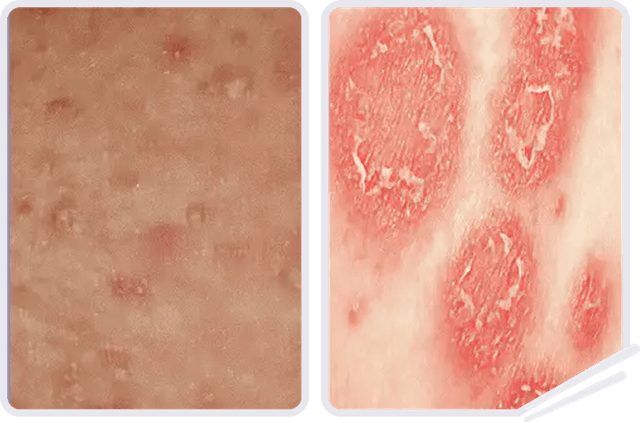
Between flares, GPP skin symptoms may include scaling, erythema, and pustules.7
In a post hoc analysis, evaluating disease burden in untreated GPP patients, GPP negatively impacted patients, even in the absence of a flare.8
Post hoc analyses, even those based on observations from clinical trials, are not intended to be compared with results from prespecified analyses of controlled clinical trials. Differences in patient populations, outcome definitions, and methods of collecting data make it inappropriate to compare this analysis to controlled clinical trial outcome data. Data from a post hoc analysis should be viewed as relevant supplementary information. No information from this post hoc analysis should be in any way construed as making any claim about the efficacy, safety, or appropriateness of any specific therapy.
GPP, generalized pustular psoriasis; GPPPGA, Generalized Pustular Psoriasis Physician Global Assessment; PSS, Psoriasis Symptoms Scale; VAS, Visual Analogue Scale.
aPatient-reported severity of pain was evaluated using the Pain VAS score (continuous scale 0-100; 0-4=no pain, 5-44=mild pain, 45-74=moderate pain, 75-100=severe pain).8
bPatient-reported severity of GPP symptoms was evaluated using the PSS score (0=no symptoms, 4=mild symptoms, 8=moderate symptoms, 12=severe symptoms, 16=very severe symptoms).8
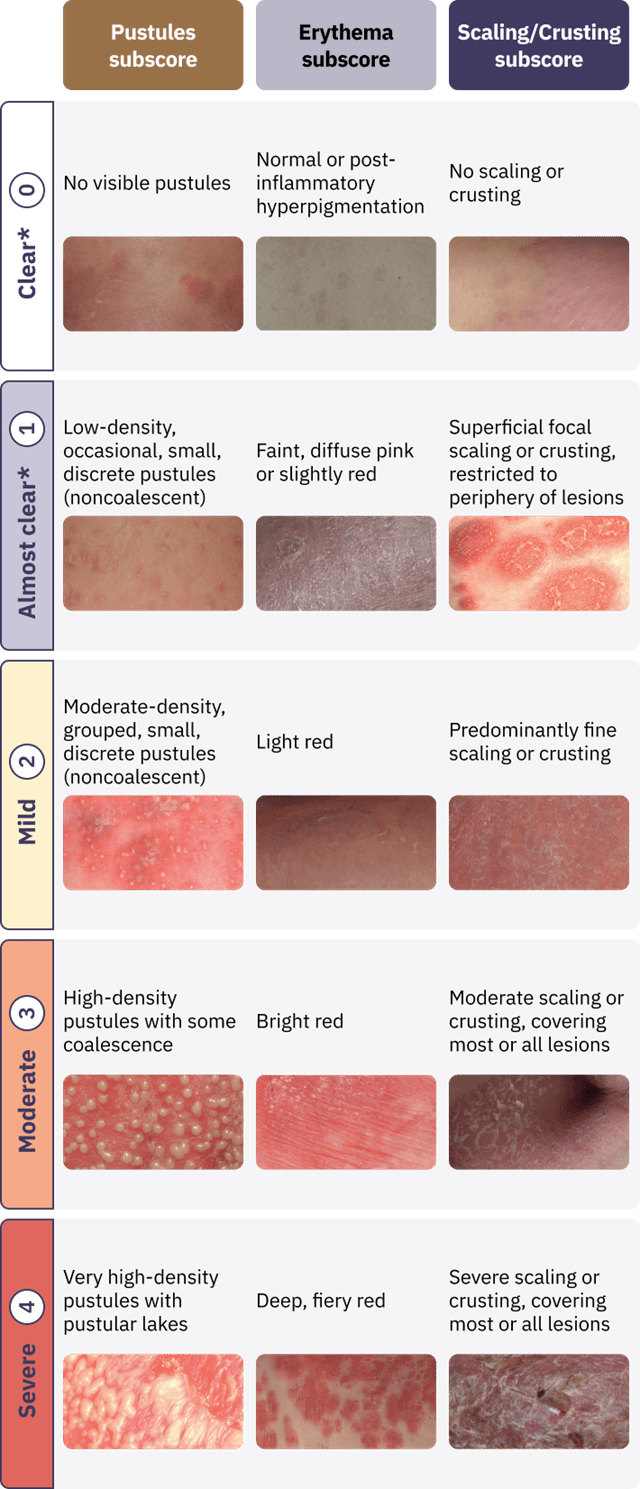
The GPPPGA total score ranges from 0 (clear) to 4 (severe) and is determined by averaging the subscores of pustules, erythema, and scaling. These components are graded separately. The average is calculated: 0a (0 for all 3 components), 1a (average is >0 to <1.5), 2 (average is 1.5 to <2.5), 3 (average is 2.5 to <3.5), or 4 (average is ≥3.5).9,10
GPP, generalized pustular psoriasis; GPPPGA, Generalized Pustular Psoriasis Physician Global Assessment.
aTo receive a score of 0 or 1, the patient should be afebrile, in addition to skin presentation requirements.10
Learn more by watching this video
Watch expert Dr. Adam Friedman, Professor and Chair of Dermatology at George Washington University School of Medicine and Health Sciences, discuss treatment goals and the importance of continuous GPP treatment.
Please see Important Safety Information below.
Dr. Adam Friedman has been compensated for his time.

The National Psoriasis Foundation advocates that GPP patients need timely access to FDA-approved therapies9
FDA, US Food and Drug Administration; GPP, generalized pustular psoriasis.
SPEVIGO is indicated for the treatment of generalized pustular psoriasis (GPP) in adults and pediatric patients 12 years of age and older and weighing at least 40 kg (88 lb).
SPEVIGO is contraindicated in patients with severe or life-threatening hypersensitivity to spesolimab-sbzo or to any of the excipients in SPEVIGO. Reported hypersensitivity reactions have included drug reaction with eosinophilia and systemic symptoms (DRESS) and anaphylaxis.
Infections: SPEVIGO may increase the risk of infections. In patients with a chronic infection or a history of recurrent infection, consider the potential risks and expected clinical benefits of treatment prior to prescribing SPEVIGO. Treatment with SPEVIGO is not recommended in patients with any clinically important active infection until the infection resolves or is adequately treated. Instruct patients to seek medical advice if signs or symptoms of clinically important infection occur during or after treatment with SPEVIGO. If a patient develops a clinically important active infection, discontinue SPEVIGO therapy until the infection resolves or is adequately treated.
Risk of Tuberculosis: Evaluate patients for tuberculosis (TB) infection prior to initiating treatment with SPEVIGO. Avoid use of SPEVIGO in patients with active TB infection. Consider initiating anti-TB therapy prior to initiating SPEVIGO in patients with latent TB or a history of TB in whom an adequate course of treatment cannot be confirmed. Monitor patients for signs and symptoms of active TB during and after SPEVIGO treatment.
Hypersensitivity and Infusion-Related Reactions:
Vaccinations: Prior to initiating SPEVIGO for treatment of GPP, complete all age-appropriate vaccinations according to current immunization guidelines. Avoid use of live vaccines in patients during and for at least 16 weeks after treatment with SPEVIGO. No specific studies have been conducted in SPEVIGO-treated patients who have recently received live viral or live bacterial vaccines.
Intravenous SPEVIGO for Treatment of GPP Flare (Study Effisayil-1): Most common adverse reactions reported in ≥5% of patients treated with SPEVIGO in the clinical trial were asthenia and fatigue, headache, nausea, pruritus and prurigo, infusion site hematoma and bruising, and urinary tract infection (UTI).
Specific Adverse Reactions
Subcutaneous SPEVIGO for Treatment of GPP When Not Experiencing a Flare (Study Effisayil-2): Regarding the exposure-adjusted incidence rates for subjects on randomized treatment prior to receiving rescue treatment for flare or completing trial without a flare, the rate per 100-patient years for injection site reaction (including erythema, pain, swelling, induration, urticaria, and warmth at the injection site) was 31.6 for the subcutaneous SPEVIGO cohort (600 mg loading dose followed by 300 mg every 4 weeks) vs 12.7 for the placebo cohort. The rate per 100-patient years for UTI was 18 for SPEVIGO vs 0 for placebo. The rate per 100-patient years for pruritus was 8.8 for SPEVIGO vs 0 for placebo. The rate per 100-patient years for arthralgia was 13.3 for SPEVIGO vs 6 for the placebo cohort. There were 3 subjects who discontinued subcutaneous SPEVIGO due to treatment-emergent adverse events of psoriasis compared to no subjects in the placebo cohort who discontinued placebo for any treatment-emergent adverse event.
Safety in Study Effisayil-2 After Flare: In Effisayil-2, subjects who experienced a GPP flare and received at least one dose of an open-label single intravenous 900 mg dose of SPEVIGO were treated with open-label subcutaneous SPEVIGO 300 mg. These subjects (n=19) received subcutaneous dosing at every 12 weeks, which could have been increased to every 4 weeks based on GPPPGA total score or pustulation subscore increased by ≥1 from any previous open-label maintenance visit. The reported safety profile of open-label subcutaneous SPEVIGO use after treatment of GPP flare with open-label intravenous SPEVIGO use was consistent with the safety profiles of use of SPEVIGO from Trial Effisayil-1 and randomized controlled data from Trial Effisayil-2.
Clinical Development of Spesolimab-sbzo
Pediatric Use: The safety and effectiveness of SPEVIGO for the treatment of GPP have been established in pediatric patients 12 years of age and older and weighing at least 40 kg. Use of SPEVIGO for this indication is supported by data from a randomized, placebo-controlled study, which included 6 pediatric subjects 14 to 17 years of age with a history of GPP treated with subcutaneous SPEVIGO (Study Effisayil-2), and evidence from an adequate and well-controlled study of intravenous SPEVIGO in adults with GPP (Study Effisayil-1), with additional pharmacokinetic analyses showing similar drug exposure levels in adults and pediatric subjects 12 years of age and older and weighing 40 kg or more. The safety and effectiveness of SPEVIGO in pediatric patients younger than 12 years of age or in pediatric patients weighing less than 40 kg have not been established.